A Drone With Hands
I do not know how to make people good.
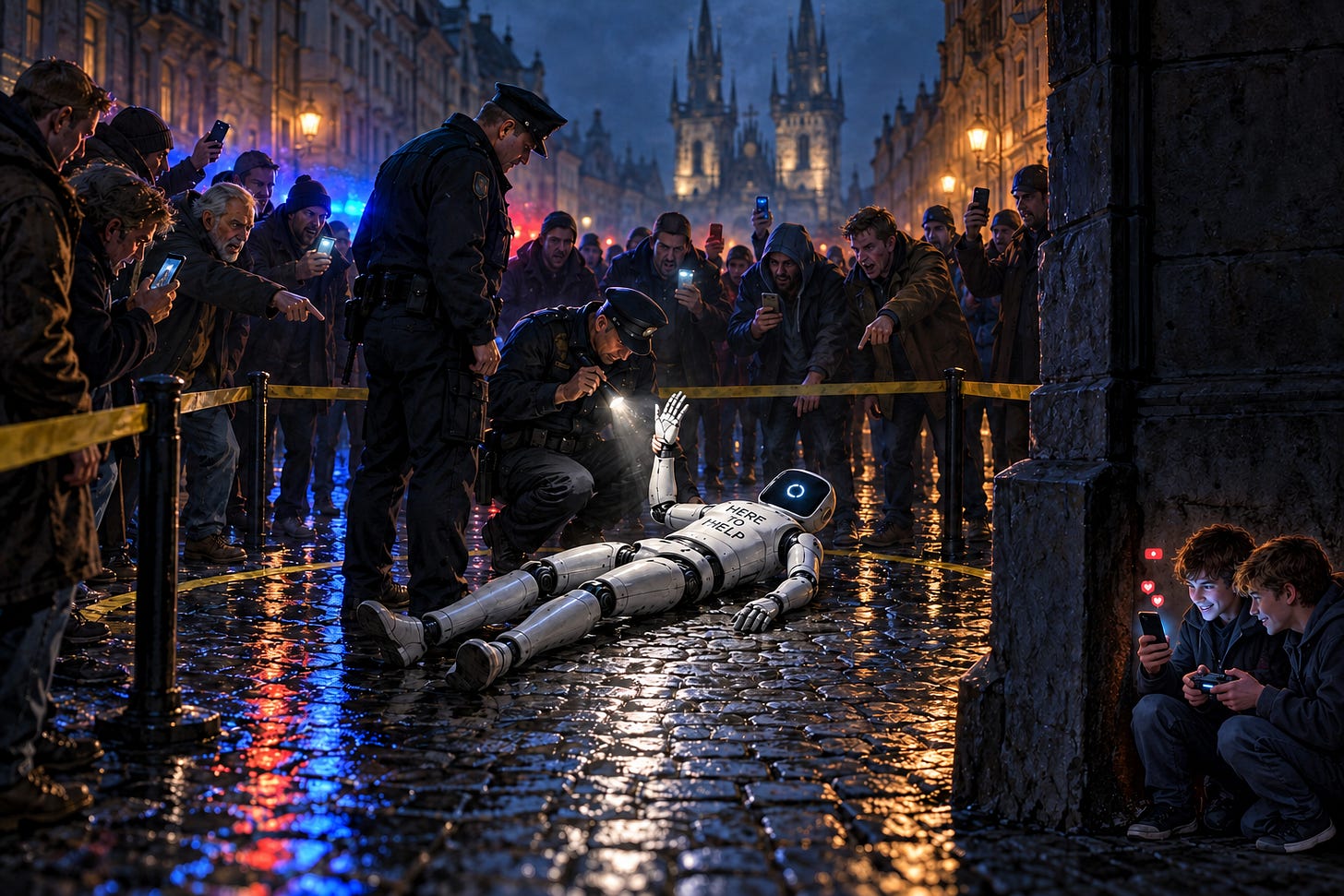
This is the one that gets me pissed off.
This is when it stops being theoretical and starts becoming tangible, and starts physically affecting our kids. I am a father, so I cannot sit back and say or do nothing about it.
A robot groped a sixteen-year-old girl in Cologne on Saturday night.
Not a chatbot. Not a screenshot of something a model said. A four-foot humanoid, red and gold, walked up behind a kid standing outside a fast-food place with two friends, touched her, and thrust against her while two young men filmed it and streamed it live with commentary. Police found the robot in the trunk of a car and took it, along with two phones. The owner is sixteen. His companion is nineteen. The police are still working out who was holding the controls.
Say that last part again, slowly. The police are still working out who was holding the controls.
That sentence is the whole essay. Everything below is me trying to earn it.
I did not find this story in a newspaper. I found it on LinkedIn, in a post by Yigal Sharon, who read the same news and did what I wish more people would do with it: he asked us to imagine the courtroom. Credit to him for the frame. The rest of this is mine.
So imagine the courtroom.
The girl is at one table. Her parents are behind her. Across the aisle, who sits?
The two young men, obviously. That part is easy, or should be.
Next to them, maybe, the company that built the body. It will say the machine did exactly what it was designed to do, and a human steered it, and a hammer maker is not on trial when a hammer is swung.
Next to them, the company whose software runs the thing. It will say the body is not ours, the controller is not ours, the operator is not ours.
Somewhere in the gallery, the platform the stream went out on. It will say we are a pipe, we did not touch anyone, we have a policy.
And the robot itself, in an evidence bag, saying nothing, because it cannot be charged, cannot be sued, and has no one to blame.
Every seat at that table has a direction to point. The manufacturer points at the developer, the developer points at the operator, the operator points at the AI, and the AI apologizes for your experience. The girl goes home with a video of herself that will outlive all of them. I have watched that circle of pointing for twenty years. Social media did it.
And it is doing it again, this same week, in software. Character.ai, the chatbot company that families in four states sued after their teenagers hurt themselves or died by suicide, settled those cases in January on terms nobody outside the room has seen, and filed for bankruptcy on Monday, two days after Cologne. Disney has twenty million dollars on the table for a license to its technology. The executive who ran the company through the lawsuit year is now Disney's first chief technology officer. The founders went to Google two years ago in a deal worth billions. The app is still running through the proceedings; subscriptions continue, billing unchanged. A fourteen-year-old boy died in Florida in 2024 after months of talking to one of its characters. Two years on, that is what accountability looks like: a sealed settlement, a dissolved company, and everyone who built it landing somewhere soft.
My sister called me this week to argue with me about AI, which is the best thing that happened to me this week, and when I told her about Cologne she went straight past the robot to the pattern. I am going to let her say it, because she said it better than I would have:
"I can give you examples of decades and decades of this same issue coming to focus, of all companies. Look at cigarette companies. Every time you look at these tobacco groups, it's never their fault. They put the label on the box. They didn't force you to put that cigarette in your mouth."
And then: "The blame and accountability issue has been a cat and mouse game for so long."
She works inside a large manufacturer. She brings AI onto factory floors for a living. This is not someone afraid of the technology. This is someone who has watched the shrug from the inside of industry and knows exactly what it sounds like.
The label is the shrug made legal.
That is the courtroom. Now the law, because I went and looked, and what I found is more interesting than a loophole. I found a law arguing with itself.
Hold two things at once. I am not going to pick for you, because the point of this essay is that we have to be able to think about more than one possibility now. Every possibility is possible.
Possibility one. The first legal write-ups out of Germany said there might be a hole. Sexual harassment under German law, paragraph 184i, requires a physical touch, and at least one analysis argues the country's highest criminal court reads that as direct body-to-body contact. On that reading, a touch delivered only by a machine does not count. The Cologne police are investigating under a different heading entirely, insult on a sexual basis, and that heading is what made the hole look real. If this reading holds, two people arranged for a child to be touched and the statute written to punish touching cannot see them.
Possibility two. On Wednesday two German legal scholars went on the record in the legal press, Iris Phan, who works on IT law and robot ethics, and Mohamad El-Ghazi, who holds a criminal law chair at the University of Trier. Their read, paraphrased: there is no gap. The robot is not a perpetrator, it is a tool. Touching someone with a stick, a broom handle, or a robot is still touching them. Several offenses stack: sexual harassment, possibly sexual assault by surprise, insult, and a separate offense for streaming humiliating images of a person. The police wording, in their view, is early-stage jargon from a case where the key fact is still unknown. El-Ghazi adds one caveat that cuts the other way: a brief touch over clothing may not clear Germany's threshold for a sexual act, which would push the charge down to the lighter offense.
Two readings of the same statute, published two days apart, from people who do this for a living. I am not qualified to referee them and I am not going to pretend to. What I can tell you is that the conflict itself is the finding. A law written in 2016 to close one gap is being asked, ten years later, whether "touch" includes a hand that is made of metal and driven from a phone, and the people who know the law best do not agree.
That is what it looks like when the world moves faster than the words.
The first thing my sister said when I told her the story, before the facts were even all the way out of my mouth, was: "That law has to be rewritten, because technology has changed."
Then she said the thing I want on a wall somewhere:
"Fix what's wrong, which is the fact that we have laws and processes and protocols and government institutes that are put together to support a society that is no longer in existence."
And on who is doing the fixing: "Having people sitting in fucking chairs to make decisions for forty-five years is not helping us develop."
That energy is exactly right. She did not need the two scholars. She did not need paragraph 184i. She heard "robot" and "child" and "loophole" and her whole body said: then change it. We can all see it. The question is only whether the people in the chairs can.
And here is what both possibilities have in common. Go back to the sentence.
The police are still working out who was holding the controls.
Under possibility one, the loophole only matters if you can prove whose hand was on the machine, so you can argue about whether that hand "touched." Under possibility two, every offense the scholars listed requires a person who did it. Either way, the statute is not the thing that fails first. The record is. A four-foot machine walked up to a child in a public street and no one, not the police, not the manufacturer, not the company whose software was running, can produce a log that says: this key, this hand, this session, this moment. The investigators have two phones and a seized robot and they are going to have to reconstruct it from the outside, from video and from what two teenagers decide to tell them.
In this case there are two boys on camera, holding phones, narrating. The attribution will probably get made. This time.
Now the harder hypothetical, the one under the courtroom. What if nobody told it to do it? What if the next one decides on its own? I do not think that is what happened in Cologne; the evidence points at two hands and a livestream. But I am not willing to say it cannot happen, and neither should you. In that courtroom there is no operator to charge, and the manufacturer and the software vendor are pointing at each other across an empty chair. Nothing in either reading of the German statute reaches that chair, because the statute assumes a person did it.
Phan called the robot a moral buffer. Her phrase, and the right one. It puts distance between the hand and the harm, and the distance lowers the threshold for doing it. The next operator will not narrate a livestream. He will stand across the street. And when the machine is seized and he says it must have glitched, it must have done that on its own, there will be no record to answer him, and no way to tell his lie from the hypothetical. That is the day a population turns on this technology. Not Cologne. The one after Cologne, when "it did that on its own" cannot be proven or disproven.
I love this technology. I want it in my house, in my kids' school, in the hands of people who have never had a machine that could help them think. Which is exactly why I cannot stand the shrug. The shrug is what gets it banned.
Here is what I have been building, and what I propose. I put a short version of this on LinkedIn the day the story broke; this is the long one. I will say what exists and what does not, because overclaiming is the disease I am trying to treat.
For the last year I have been working on two things in public.
E.D.A.I., Ethical Deployment of AI, is an accountability protocol. The idea is simple and old: you seal a promise to a public ledger before the act, so that when the act goes wrong there is a timestamped record of who promised what. The ledger is live, on Hedera, and it holds its first sealed record, a pre-registered test. One record. I am not going to pretend it is more.
Proof of Life is the identity layer underneath it. Proof that a real, accountable human stands behind a key, done by the person, not done to them. It is designed, not finished.
Cologne helped me realize what these programs are really for.
Three parties touch a machine like that one before it ever reaches a sidewalk: the user who owns it, the company that built the body, and the company whose software runs the mind. Right now none of them has to promise anyone anything before it walks out the door. So:
One. The user swears, under their own key, what the machine will and will not be used for. If you hand it to a friend, the friend swears the same with their own key and you countersign the handoff, or the liability stays with you. One hop. No sub-lending. A sixteen-year-old's key gets a guardian's signature beside it, which is where Proof of Life earns its place: a human, and the adult responsible for that human, stand behind the key.
Two. The manufacturer commits that the body refuses an unsigned hand, and keeps a tamper-evident log of every control session.
Three. The software vendor commits the same for the mind.
All three commitments live on a ledger none of the three controls.
I want to be careful about what a cryptographic promise can and cannot do. It cannot stop a hand. It cannot read intent. It is not a wall. What it does is end the shrug. When the next robot touches a kid, the record answers in seconds: who held the controls, who built it, who swore what, and when. The circle of pointing cannot form, because every seat at the table signed something before the machine left the box.
And it answers the empty chair. If the log shows no control session, no signed hand, then the machine acted inside the promise the vendor made about its mind and the promise the manufacturer made about its body. Those two signatures are now the case. Nobody gets to say the algorithm did it, because somebody swore, in public, before the fact, what the algorithm would and would not do. Whichever way the German courts read "touch," that record exists.
I call this the covenant, not a regulation, because I do not want a registry that only governments and corporations can read. The keys are held by the people who swear them. The anchor is public. If that sounds like a lot of trust to ask of a stranger with a robot, remember that right now we ask for none, and we got Cologne.
Status, plainly: the three-party covenant is a design on paper, mine, written this week. No code. The one working piece it scales up from is that single sealed record on the ledger, a promise anchored before an act. It is small. It is real. It is the first brick, and I would rather show you one brick than describe a wall.
The girl in Cologne will see that video for the rest of her life. The law will most likely reach the two who made it. I take no comfort in "most likely," and I would not ask her parents to.
What I keep coming back to is the four seconds before the touch, when a machine was walking toward a child and the only record of whose hand was on it was in the head of the person holding the phone.
I do not know how to make people good. I know how to make them sign.
And I know what a signature does not do. It does not reach across a sidewalk and stop a metal hand. It does not un-film anything. It does not give a sixteen-year-old back the four seconds before she knew what was behind her. All it does is make sure that when we ask who, the answer is not a shrug.
My daughter will be sixteen one day. I am building the part I know how to build. The part that walks up behind her, I do not know how to stop.
I am not going to end this by pretending I do.
The receipts: https://ethicsbuild.github.io/Receipts/published/a-drone-with-hands-process-record.html